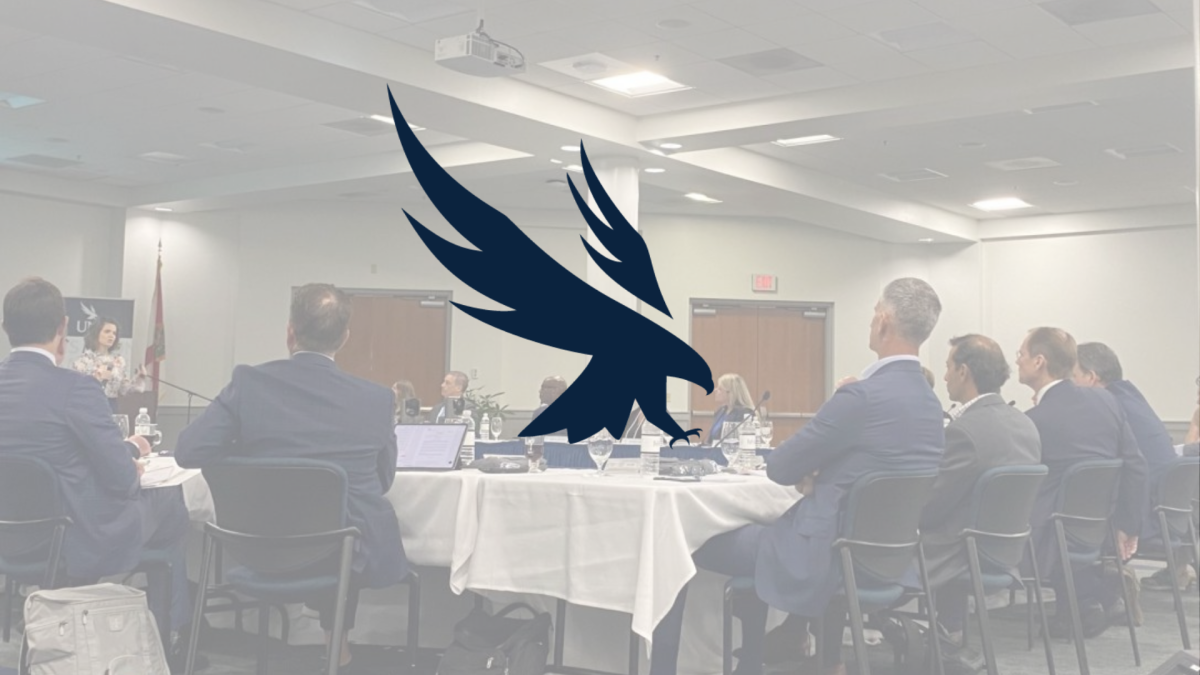



As the Florida Board of Governors (BOG) convened for a two-day meeting from March 25 to 26, the group discussed wide-ranging topics, from ongoing presidential searches to growing concerns over transparency, degree requirements and artificial intelligence.
During the all-encompassing meeting, the board addressed presidential vacancies at the University of North Florida and the University of Florida and the lack of development of a graduate campus in Jacksonville between UNF and UF.
The BOG also discussed AI in higher education and the possibility of Florida’s universities offering 90-credit-hour Bachelor’s degrees, compared to the standard 120-credit-hour degrees.
Presidential Search Update
During the BOG meeting, Chairman Alan Levine said that UNF and UF are still looking for permanent presidents.
Levine also noted that the UNF Presidential Search Committee will have its first meeting on March 31. According to Levine, the executive search firm Funk & Associates has been engaged to assist with the process.
UF and UNF Task Force Update
In 2024, UF partnered with UNF to form a joint task force to continue developing a graduate campus in Jacksonville.
But during the Budget and Finance Committee meeting, board member Aubrey Edge expressed discomfort with the lack of updates from both universities regarding the Jacksonville campus project.
“I’m not making any assertions that there wasn’t a cooperative spirit going on, but it still doesn’t change the fact that I have no idea what was going on,” said Edge. “I think the board of governors was specifically supposed to be included in this process.”
UNF Interim President Dr. Angela Falconetti, who noted she had been in her role for five weeks at the time of the meeting, provided her perspective on the status of the joint task force.
“There are high-level discussions that occurred in the past, yet I don’t have a full report from that task force,” said Falconetti. “So we are looking forward to the future which is advancing naturally with our SUS 30 plan.”
The SUS 30 Plan is the Florida State University System’s new strategic plan through 2030, composed of 12 distinct universities all collaborating as one system.
UF Interim President Dr. Donald W. Landry noted that UF reduced its initial proposal of ten programs down to seven for its graduate campus. This was done to avoid competition with similar programs that UNF also offers.
“There was a specific request from the University of North Florida that we not go forward with a Master’s of Health Administration,” said Landry. “We deleted that from our plans. We were left with a core group that would not be competitive.”
Reduced Credit Hour Degrees Overview
In Florida, students need at least 120 semester credit hours to earn a bachelor’s degree unless the Board of Governors makes an exception. Some universities in other states offer bachelor’s degrees that require fewer credits.
During her presentation, Dr. Lynn Nelson, Associate Vice Chancellor for Academic Affairs & Innovation, gave an overview of what the board should consider if the Florida State University System decides to offer bachelor’s degrees with fewer credit hours.
“Following the meeting, board staff will plan to work with universities on establishing criteria and a process for programs with fewer than 120 credit hours,” said Nelson. “This will be included in a board regulation, which we plan to present to the board in June. If approved, universities would be able to submit program proposals for consideration in the fall.”
At Northern Arizona University, students can earn a Bachelor of Professional Studies in Engineering Technology with just 90 semester credit hours. Accreditors like the Higher Learning Commission (HLC) have approved more degrees like this.
Falconetti said that UNF is exploring bachelor’s degrees with fewer credit hours, with a focus on meeting workforce needs.
Florida’s University Leaders Grapple With AI
The State University System of Florida (SUS) created an artificial intelligence and cybersecurity task force, which held a discussion on AI in higher education during Wednesday’s Board of Governors meeting at the University of West Florida.
The SUS created the task force “because of all the potential risks that do exist for us out there with the increased use of AI, but also the opportunities,” according to Board of Governors Chair Alan Levine.
The Florida board welcomed Google Public Sector’s chief technology officer Chris Hein, to discuss the benefits and drawbacks of artificial intelligence.
Hein said that to integrate AI into the State University System of Florida, the right parameters need to be in place.
“We need to be able to put the right guardrails in place, so that when you’re using artificial intelligence at a university system, you’re keeping in mind that there is this incredible opportunity, and yet there is also going to be quite a bit of risk that we need to be able to accommodate for,” he said.
At UNF, university leaders discussed AI in higher education during a Board of Trustees meeting last December. While there were mixed reactions from students, board members and faculty on the matter, UNF continues to roll out AI certifications.
Edward Haddock, a board member and chairman of the Task Force on Artificial Intelligence and Cybersecurity, said the task force will soon issue a report with recommendations on AI use at Florida’s public universities.
___
For more information or news tips, or if you see an error in this story or have any compliments or concerns, contact [email protected].