

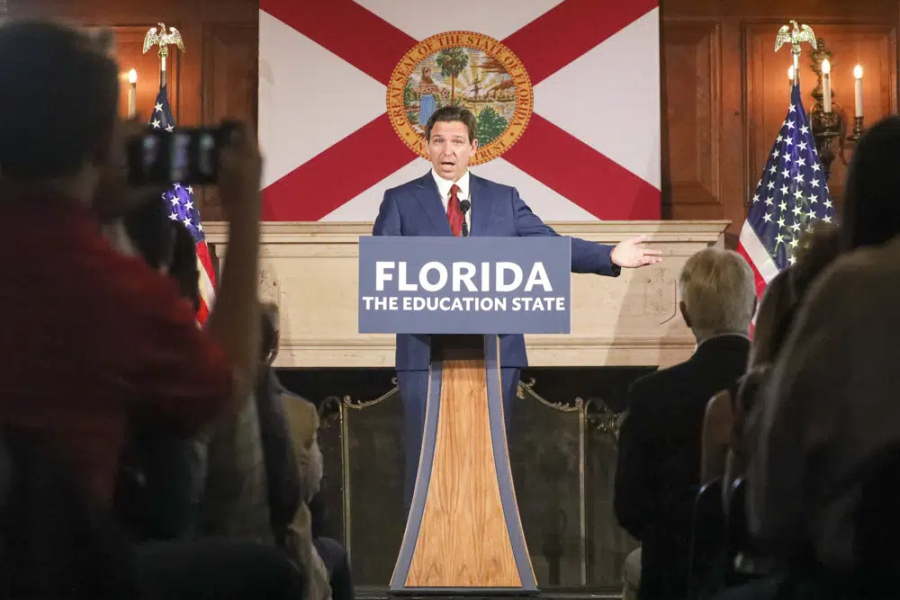
With Gov. DeSantis term-limited and the 2026 gubernatorial race heating up, a field of candidates will determine whether Tallahassee continues strict oversight of university campuses like the University of North Florida.
For the past several years, Florida’s public universities have seen the dismantling of Diversity, Equity, and Inclusion (DEI) programs, changes to post-tenure review, and the high-profile ideological restructuring of New College.
For UNF students, the stakes in the state leadership shift have never been higher.
Republican frontrunner
On the Republican side, the race is currently being dominated by U.S. Representative Byron Donalds. Armed with President Donald Trump’s endorsement, Donalds is the projected frontrunner in the Republican primary.
According to a recent statewide poll by the UNF Public Opinion Research Lab (PORL), Donalds holds a lead in hypothetical general election matchups, securing 42% of the vote against Democrat David Jolly’s 36%. In a matchup against Democrat Jerry Demings, Donalds leads 43% to 36%.
“At least at this stage in these races, vote choice is much more about partisanship than candidate identity,” Dr. Sean Freeder, PORL director and professor of political science, stated. “Republicans still enjoy a clear advantage with Florida voters, but it doesn’t yet appear as strong as in previous years, perhaps unsurprising given that the party of the President usually struggles more in midterm elections.”
During his time in the Florida House of Representatives, Donalds championed school choice and parental rights in education. His campaign for governor promises to continue the “America First” conservative agenda.
For the Florida State University System, a Donalds administration would likely mean keeping the DeSantis’ initiatives and policies.
The governor holds the power to appoint members to the state’s Board of Governors, which oversees the entire Florida State University System.
In turn, this influences UNF’s Board of Trustees, directly affecting everything from tuition rates and presidential searches to funding for student organizations and the approval of academic programs.
“I don’t think we realize how much ends up impacting us until it does,” UNF junior Dillion Stafford said. “The average person probably doesn’t know about the SUS or governor candidates or anything, and then we complain when the people in charge do things that hurt us.”
Democratic challengers
On the other side of the aisle, Democrats are positioning themselves as the antidote to the DeSantis era, promising to reverse recent policies. However, their primary is shaping up to be a complex battle, especially when it comes to winning over Gen Z voters.
Recent PORL polling indicates that in hypothetical matchups against Donalds, only 41% of respondents aged 18 to 34 would vote for Jolly, and 39% would vote for Demings.
Currently leading the Democratic polls is David Jolly, a former Republican congressman. Jolly’s path to the governor’s mansion requires heavy mobilization from progressive college students, who may be highly skeptical of his past conservative stances, particularly on reproductive rights.
“I don’t know much about Jolly or any of the governor candidates, but I know I’m not voting conservative,” UNF freshman Allyson Young said.
Also in the race is Orange County Mayor Jerry Demings. Both Jolly and Demings have signaled that a Democratic administration would halt the state’s intervention in higher education.
According to Jolly’s website, he “aims to reverse many of Governor Ron DeSantis’s policies,” including “removing DeSantis’s appointees, increasing teacher pay, and reviving growth management policies”.
“When Tallahassee preempts local governments from being able to make decisions for themselves, you’re at that point adversely impacting the will of the people, and that is something that has to change,” Demings told a reporter while speaking in Tampa.
Important election dates
Primary Election 2026
- Deadline to send vote-by-mail ballots to UOCAVA voters: July 4
- Deadline to send vote-by-mail ballots to domestic voters: July 9 – 16
- Deadline to register to vote or change party affiliation: July 20
- Deadline to request that ballot be mailed: August 6
- Early voting period (mandatory period): August 8 – 15
- Election Day: August 18
General Election 2026
- Deadline to send vote-by-mail ballots to UOCAVA voters: September 19
- Deadline to send vote-by-mail ballots to domestic voters: September 24 – October 1
- Deadline to register to vote: October 5
- Deadline to request that ballot be mailed: October 22
- Early voting period (mandatory period): October 24 – 31
- Election Day: November 3
___
For more information or news tips, or if you see an error in this story or have any compliments or concerns, contact [email protected].