

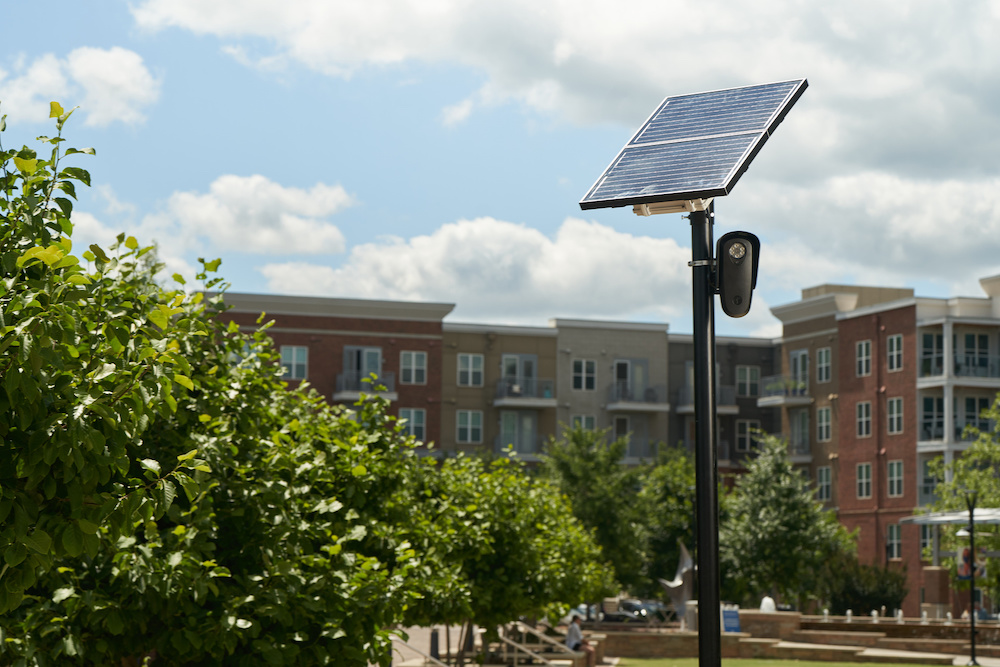
As students navigate the University of North Florida and the greater Jacksonville area, Flock Safety cameras are becoming a common sight, reshaping law enforcement strategies and sparking discussion about privacy.
Flock Safety, a leading provider of automatic license plate reader (ALPR) technology, utilizes ALPRs to capture license plate information and cross-reference it with law enforcement hit lists and the National Crime Information Center.
Surveillance and privacy concerns
As UNF continues to balance campus safety with citizen concerns, Flock Safety cameras represent a controversial tool in modern policing.
UNF graduate Gabrielle Wilson said that although she knows ALPRs have been used to help solve crimes, the “amount of government surveillance is concerning”.
“I’m not sure how much regulation it [ALPRs] has with our government,” said Wilson. “Kind of like AI, it seems like a lot of power, and I don’t know if the pros outweigh the cons.”
While the exact number of Flock cameras currently active on the UNF campus or across Jacksonville is not specified in the available scientific datasets, a website called DeFlock tracks active ALPRs.
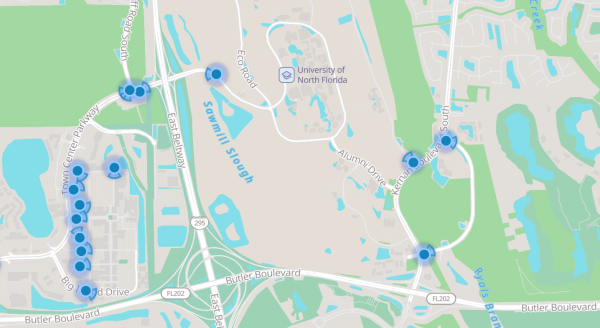
There are three Flock cameras on UNF Drive and Town Center Parkway, two on Kernan Blvd and First Coast Tech Parkway, and 9 in St. Johns Town Center, according to the website.
UNF freshman Owen Locke said he had seen the Flock cameras around the area but wasn’t sure what they were.
“It seems a little weird and futuristic to be monitored like that all of a sudden,” said Locke.
However, Ally Hurst, a UNF sophomore, said that the Flock cameras could be useful for catching people who speed around the university.
“It’s really dangerous how fast people drive in Jacksonville,” said Hurst. “If the cameras help catch those people, I’m all for it.”
While Florida Statute 316.0777 keeps the actual images and personal data captured by ALPRs confidential, Florida departments such as the Florida Highway Patrol have opted into public-facing portals to detail their data schedules, operational camera counts, and internal audit logs.
The Jacksonville Sheriff’s Office (JSO) launched its formal Transparency Portal in August 2024, but this portal does not detail operational ALPR camera locations, search audit metrics, or direct hardware vendors.
Rise of ALPRs in Florida and Jacksonville
Although ALPR technology first came to the United States in 1998 as a form of border security, its capabilities have evolved into a powerful tool for mass data collection by local police forces.
A 2020 survey of 1,237 law enforcement agencies across 39 states found that 40% used ALPR systems, a significant increase from 23% in 2009.
In Florida, the deployment of Flock Safety cameras surged in the early 2020s through an Axon partnership that sought to integrate Flock’s ALPR data directly into existing police evidence networks.
During this boom in the early 2020s, the Jacksonville Sheriff’s Office (JSO) accelerated its adoption of Flock cameras, integrating the solar-powered systems across the city to track vehicular movement and respond to crime as part of JSO’s “Real-Time Crime Center” initiative.
The American Civil Liberties Union said that ALPR tracking requires “clear regulations” to prevent the “government from tracking our movements on a massive scale”.
“Automatic license plate readers have the potential to create permanent records of virtually everywhere any of us has driven, radically transforming the consequences of leaving home to pursue private life, and opening up many opportunities for abuse,” said the ACLU on its website.
___
For more information or news tips, or if you see an error in this story or have any compliments or concerns, contact [email protected].