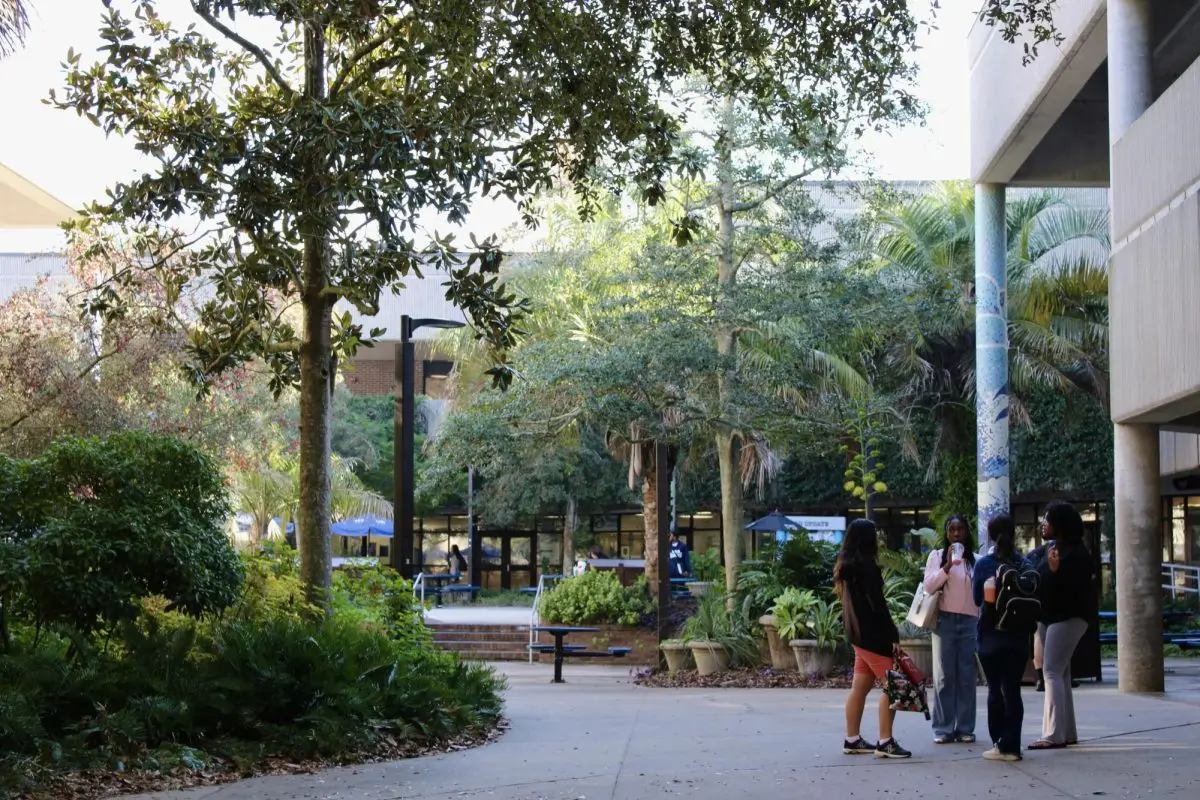



The University of North Florida Student Government (SG) validated the Spring 2026 election results on Friday, officially naming Talon Party candidates Hazel Joseph and Tommy Mazzella as student body president and vice president. Senators also debated a series of constitutional revisions related to student events and the auditing of registered student organizations (RSOs).
Spinnaker also spoke to current SG Senators and UNF students who expressed concern that the newly elected Senate does not accurately represent the student body.
Validation of results
Hazel Joseph and Tommy Mazzella from the Talon Party won the UNF Student Government Spring 2026 presidential election as student body president and vice president.
Supervisor of Elections Asvidhi Ladumor read the unofficial results aloud during the Senate meeting, followed by Senate discussion.
Senator Hunter Hayes, who ran for the vice president seat in the opposing SAM party, offered his congratulations to the incoming administration.
“We are all here in the Student Government to do what’s best for the students,” said Hayes. “At the end of the day, I believe that Hazel Joseph and Tommy Mazzella will do what’s right for the student body.”
After the discussion, the senate validated the results with 11 votes. Nine senators abstained because they were on the ballot.
Student Opinions
After SG released its unofficial election results, some students expressed concern that the newly elected Senate does not accurately represent the student body.
In the results, 20 of the student senators elected were from the SAM party — Hailey Elias, University and Student Affairs (USA) Chair Shipton Macdonald, and Troy Montinola.
Before the election results were validated, two SAM members spoke with Spinnaker about their concerns regarding representation and party legitimacy in SG.
“I’m concerned with the people elected, because there’s an overwhelming amount of Greek life,” said Macdonald.
Though both Elias and Macdonald are involved in Greek Life at UNF, they said students from international, religious, and non-Greek Life backgrounds should also have a voice in the Senate.
“I heard some people complaining that there should not be a majority senate body being Greek Life,” Elias said. “That doesn’t reflect every student here. I feel that it should have been more diverse.”
Macdonald also questioned whether having political parties within SG truly matters once elections conclude.
“Another question to bring up is, what’s even the legitimacy of parties in elections?” Macdonald said. “Once the election is over, we don’t talk about parties until next election season.”
Former senator and fraternity member Christian Shore shared a similar concern, noting that perceptions about Greek Life may discourage some students from participating in SG elections.
“There’s a lot of negative connotations with it, and for that reason, people might not want to participate in the election,” Shore said.
Other students also raised concerns about inclusivity and awareness. UNF student Umaiza Toor, who split her votes between the Talon and SAM parties, said that while she was pleased with the outcome of the Student Body President election, most of the Senate candidates she supported were not elected.
“I do believe that Muslim voices, or minority religious voices, are missing, as well as regular non-sorority [and] fraternity voices,” Toor said.
Another student admitted they did not vote because they were not informed enough about SG to participate.
“In all honesty, I didn’t pay much attention to the election,” said psychology student Fiama Villafan. “A lot of people are more serious in their political views. When it comes to voting, it has gotten to the point where it doesn’t exactly feel safe to vote, in my opinion.”
Midterm Madness or Finals Frenzy?
A proposal from the University and Student Affairs (USA) Committee was sent back for revisions after a 16-2 vote by the Senate on Friday.
Sen. Macdonald proposed two changes to Title XII of the SG Constitution: requiring senators to conduct Osprey Voice monthly and shifting responsibility for Midterm Madness from Finals Frenzy to the USA Committee. The proposal drew debate over whether replacing Finals Frenzy with Midterm Madness was in students’ best interest.
Sen. Brooke Deluccia pushed back on the change, noting that most of her classes have finals rather than midterms, and points out that students will still feel burnout at the end of the semester.
“Shouldn’t we be doing what’s best for students and not what’s easiest to plan?” said Deluccia.
Sen. Lily Vazquez raised concerns about the ambiguity of when Midterm Madness would be held, given that students have midterms at different times, and suggested keeping both events on the table.
“It makes me wonder if you can do both and have a Midterm Madness day and then do a Finals Frenzy week,” said Vazquez.
Senator Ignacio Castaneda motioned to return the proposal to committee, and the Senate voted 16-2 in favor, with Macdonald abstaining as the bill’s author. Senators Hunter Hayes and Jack Yanow cast the two dissenting votes.
Following the vote, Senate President Kamyla Carrasquillo-Lebron encouraged more senators to attend the next USA Committee meeting to ensure a broader range of perspectives are represented in future revisions.
Stricter Auditing for RSOs
Both Joseph and Student Body Treasurer Katherine Toro Villanueva presented revisions to the SG Constitution’s Finance Code, implementing stricter audit procedures for RSOs to strengthen financial accountability and ensure compliance with Title VIII.
UNF’s Finance Code or Title VIII governs how the Student Government collects, allocates, and spends Activity and Service fee money.
Under the proposed revised rules, the treasurer can initiate audits with OIC assistance, and RSOs must comply or risk losing their good standing and A&S funding.
Villanueva is looking to implement a structured audit process for RSOs. To initiate an audit, the Treasurer contacts the RSO in writing with assistance from the Osprey Involvement Center (OIC) Director. However, due to different schedules with the OIC Director, Villanueva often collaborates with Joseph.
“Since Hazel and I take many of the same classes, we can work together on the auditing process,” said Villanueva.
From there, the RSO would have five business days to acknowledge and begin scheduling. If the RSO does not respond, the treasurer issues escalating notices of non-compliance, each granting additional time to respond.
If RSOs fail to schedule an audit within 20 total business days, OIC will deem them “Not in Good Standing” and the RSO will lose eligibility for A&S Fee funding until they comply.
The revisions to Title VIII were passed with 18 votes.
Special Requests
After being approved by the Budget and Allocations Committee before spring break, representatives from the Latin American Student Organization (LASO), Fencing and Hema Club, and the Sculpture Guild repeated their presentations at the senate body meeting.
All three organizations had their requests approved and are now awaiting approval from the Student Body President, Amelia Dyal.
Up Next
Student Government’s Committees will hold meetings on Friday, April 3. Meeting times and locations are below.
- The Rules and Oversight Committee will meet at 10 a.m. in the Senate Chambers (Bldg. 58E, Room 3200).
- The Budget and Allocations Committee will meet at noon in the Senate Chambers.
- The University and Student Affairs Committee will meet at 2 p.m. in the John E. Sapp Conference Room (Bldg. 58E, Room 3206).
___
For more information or news tips, or if you see an error in this story or have any compliments or concerns, contact [email protected].