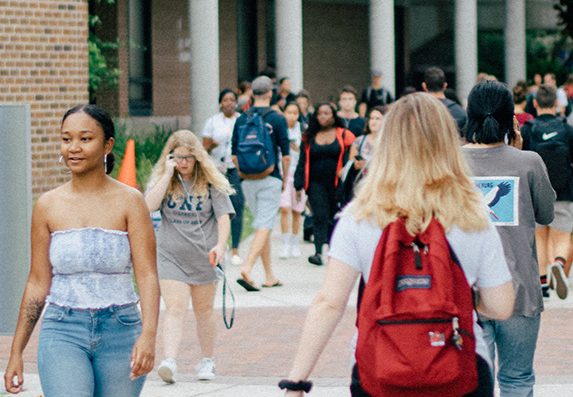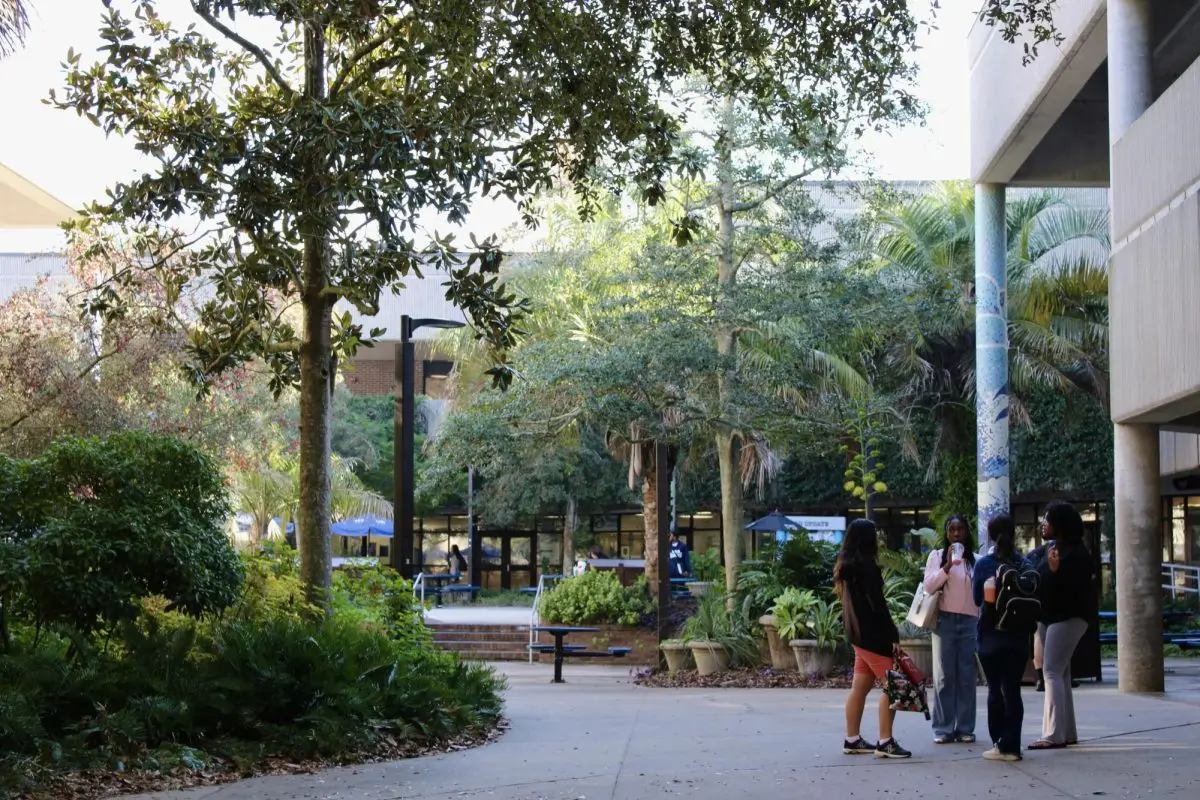



The University of North Florida is maintaining a faculty-led approach to artificial intelligence in classrooms as state higher education leaders consider systemwide guidance on the technology.
In a March Board of Governors meeting, the Florida State University System of Florida (SUS) created an artificial intelligence and cybersecurity task force, which held a discussion on AI in higher education.
The SUS created the task force “because of all the potential risks that do exist for us out there with the increased use of AI, but also the opportunities,” according to Board of Governors Chair Alan Levine.
Currently, UNF does not have a universal campuswide AI policy. According to William Klostermeyer, dean of the College of Computing, Engineering, and Construction and member of UNF’s AI council, UNF currently requires instructors to explain their own AI expectations in their course syllabi.
Faculty-led approach
UNF’s AI Council chose not to require one standard policy and instead allows individual instructors to set their own rules, according to Klostermeyer.
Klostermeyer said UNF’s Simple Syllabus system now requires professors to explicitly state their AI policy for each class. Some faculty members allow limited AI use for brainstorming or editing, while others prohibit it entirely, he said.
Megan Kuehner, interim vice president and chief information officer of UNF’s information technology services and AI council member, said the AI council was created to guide the university’s long-term approach to AI, not to impose specific classroom rules.
“My colleague and I worked with leadership to fine-tune the bylaws, establish membership, and help the committee focus on the creation of the AI strategic plan,” Kuehner said.
AI Council guides strategy
Kuehner said the council includes faculty from multiple disciplines and focuses on how AI is affecting academic work, research and broader society. Faculty research involving AI spans fields including marketing, psychology, brain sciences and writing, she said.
“There’s a lot of interest in not only using different models to conduct research, but also the implications of AI on how we interact with the world,” Kuehner said.
The university has also focused on providing access to institutionally approved tools such as Microsoft Copilot, with plans to expand access to other platforms, including Google Gemini, in the coming academic year, according to Kuehner.
Zornitza Prodanoff, a professor in UNF’s School of Computing and a member of both the AI Council and the Committee on Governmental Policy, said UNF is already addressing artificial intelligence through multiple layers of governance, training and guidance.
Prodanoff said the AI Council, the university’s AI strategic plan and training through the Center for Instruction & Research Technology are examples of UNF’s current efforts.
Statewide guidance under review
Prodanoff said possible statewide guidance from the Florida Board of Governors’ AI and cybersecurity task force could help create clearer expectations across institutions.
“Clear standards for AI use—when it is allowed, how it should be disclosed, and what counts as appropriate use—could be very helpful,” Prodanoff said. “It could also better align curricula with workforce needs like AI literacy and cybersecurity awareness.”
However, Prodanoff also warned that broad restrictions could limit academic flexibility. “Blanket bans or mandated detection tools that are unreliable could limit innovation and reduce flexibility for faculty,” she said.
As the Florida Board of Governors continues exploring AI policy across the State University System, UNF faculty said it is still unclear how statewide recommendations could affect campus-level councils or existing university guidance.
Kuehner said the task force appears interested in input from universities. “I think they are very forward-thinking in taking a proactive look at how AI is potentially changing the landscape of higher education,” she said.
Prodanoff also said the effort was forward-thinking but said effective regulation will require nuance.
Kuehner said the AI Council can make recommendations that align with university and statewide goals, but it does not directly create policy. “In general, we have the ability to craft recommendations that align with institutional and statewide goals,” she said.
Student reliance raises concerns
Ayan Dutta, a UNF computing professor and AI expert, said generative AI is already reshaping both teaching and learning. Dutta said he uses AI tools to create and revise lecture materials, produce student notes and refine research writing.
While Dutta said AI is useful, he also raised concerns about student reliance on the technology. Dutta said fewer students are coming to office hours, and attendance has dropped in his classes.
“What I used to see is students used to flock in front of my office during office hours, but now there is only one or two students,” Dutta said. “I feel the reason being they just don’t feel the necessity to come to me.”
Dutta said students sometimes submit AI-generated work without understanding assignment requirements. He said the risks are especially significant for newer computing students who may not yet know how to evaluate AI-generated responses.
“There’s a big difference between me using it after 15 to 20 years in the field and a freshman using it for the first time,” Dutta said.

AI literacy and workforce readiness
Faculty members also emphasized that AI literacy is becoming an important workforce skill. Klostermeyer said UNF’s AI for All course, along with non-credit badges and certificates, are designed to improve AI literacy across disciplines.
“It’s really important that everyone be aware of the value it can add, as well as the risks and hallucinations associated with it,” Klostermeyer said.
Prodanoff said AI literacy should be integrated into curricula but should not be limited to technical skills. “AI literacy should not just be vocational. It should develop critical thinking, creativity and adaptability,” she said.
Prodanoff said UNF’s School of Computing is working to expand interdisciplinary AI education, including undergraduate certificate programs focused on workforce readiness and responsible use.
“These programs are designed to enhance workforce readiness while maintaining a strong emphasis on critical thinking and responsible use of AI,” Prodanoff said.
Dutta said students who rely too heavily on AI may struggle after graduation. “If you are just relying on AI, that is probably okay to get the grade, but going forward, there might be big trouble in terms of getting a good quality job,” Dutta said.
___
For more information or news tips, or if you see an error in this story or have any compliments or concerns, contact [email protected].